


SaaS tool guide
Best AI Support Agent Stack 2026
Best AI support agent stack for 2026: help desk, knowledge base, escalation, QA, customer context, automation, approval gates, and human handoff tools.
Contents
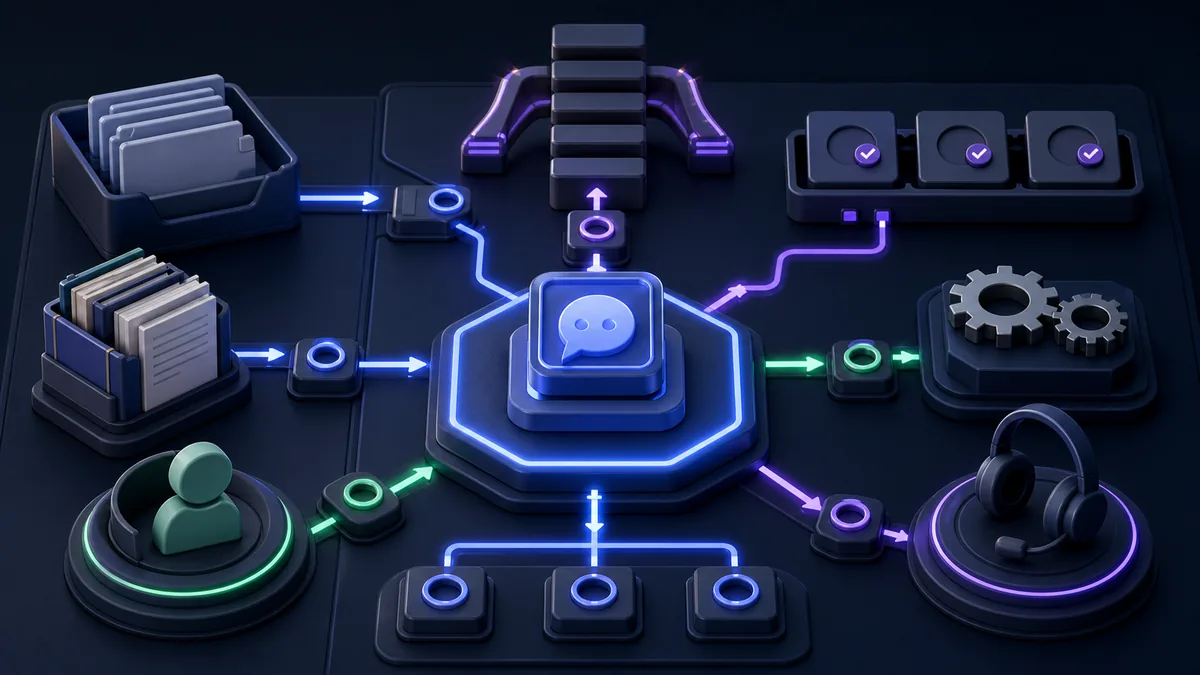
This guide is part of the AI agent execution-stack cluster and focuses on AI support agent stack selection. It is written for support leaders and operators who want faster ticket resolution without losing policy control, customer trust, or escalation quality.
Bottom line: a support agent should earn autonomy gradually. Start with triage, answer suggestions, source-linked drafts, and human handoff before allowing refunds, account changes, public promises, or sensitive customer-visible replies.
Support stack decision map
| Layer | Decision | What good looks like |
|---|---|---|
| Help desk/system of record | Where conversations, owners, SLAs, and history live | Agent actions remain visible inside the support workflow |
| Knowledge access | Which KB articles, docs, policies, and tickets can be retrieved | Source-linked answers, freshness checks, and permission-aware retrieval |
| Tool permissions | What the agent can update, send, refund, tag, route, or close | Least-privilege scopes, approval gates, audit logs, and rollback |
| Memory and customer context | What persists about customers, accounts, products, and prior cases | Tenant boundaries, deletion controls, and inspectable context |
| Evals and QA | How answer quality, escalation, and policy adherence are tested | Representative ticket sets, trace review, review queues, and feedback loops |
| Human handoff | When humans take over | Clear confidence thresholds, sensitive-topic routing, and owner accountability |
Best first support-agent use cases
| Use case | Start with | Require human approval before |
|---|---|---|
| Ticket triage | Categorize, prioritize, and route tickets | Closing tickets or changing SLA priority |
| Draft replies | Suggest source-linked answers from the KB | Sending policy-sensitive, legal, billing, security, or angry-customer replies |
| Escalation prep | Summarize history and attach evidence | Promising fixes, timelines, refunds, or exceptions |
| Knowledge gaps | Identify missing or stale help articles | Publishing customer-facing content |
| Account actions | Prepare next-step recommendations | Refunds, cancellations, data exports, deletions, credits, or permission changes |
Choose the integration pattern before the vendor
The most important support-agent decision is where the agent sits in the workflow. A help-desk-native assistant can be easier to govern because ticket history, roles, macros, and SLA rules already live in the same system. A knowledge-base or search-first assistant can be safer for early pilots because it starts with retrieval and draft answers before touching customer records. A custom orchestration layer can connect the help desk, CRM, billing, product telemetry, and internal runbooks, but it also creates more credential, logging, and ownership work.
For most teams, the clean first architecture is boring: keep the help desk as the system of record, let the agent retrieve approved sources, let it draft or route, and require a human for any irreversible or customer-visible action. That gives the support team useful speed while procurement, security, and operations can still inspect what happened. If a vendor cannot show the retrieved source, prompt, tool call, approval, and final output for a case, treat the workflow as too opaque for autonomous support.
Pilot controls and success measures
Run the first support-agent pilot on a narrow queue with clear ownership. Good pilot queues are repetitive enough to evaluate, but not so sensitive that one bad answer creates legal, financial, or account-risk exposure. Examples include routing billing questions to the right owner, drafting answers from one product area, summarizing long threads before escalation, or finding gaps in a help center.
Measure the pilot with support outcomes and risk outcomes together. Track handle-time reduction, first-response speed, source-link coverage, reviewer edits, escalation accuracy, reopen rate, customer sentiment, and cases where the agent correctly refused to answer. A support agent that deflects tickets by hiding uncertainty is worse than a slower assistant that cites sources and escalates well. Expansion should depend on trace review and eval results, not only on vendor-reported automation or deflection metrics.
Buyer governance checklist for support agents
Ask these before buying or rolling out an AI support agent:
- Which conversations and customer records can the agent read?
- Which actions are read-only, reversible, customer-visible, financial, or destructive?
- Can the agent cite the exact article, ticket, or policy that supported an answer?
- Can admins inspect and delete stored customer context or memory?
- What eval set tests bad KB articles, policy exceptions, angry customers, and low-confidence answers?
- How are hallucinated policies, stale docs, and unsafe refunds caught before they reach customers?
- What is the human handoff rule when confidence is low or sentiment is high?
- Does procurement have current vendor documentation for retention, security, logs, admin controls, and data processing?
Procurement red flags
- The product promises deflection or autonomous resolution without showing review logs and escalation controls.
- The agent can send replies, issue credits, change account data, or close tickets without approval design.
- Memory is opaque and cannot be inspected, deleted, or tenant-separated.
- The vendor treats a demo knowledge base as proof that the agent handles real policies.
- Evals do not include edge cases, stale articles, permission failures, or “ask a human” examples.
- There is no rollback path for bad replies or incorrect account changes.
Where this fits in the portfolio
- For the business-wide agent selection layer, start with best AI agent tools for business teams before narrowing this page to support automation.
- If the agent will triage tickets, answer from docs, or hand work to humans, compare the underlying systems in best help desk software for teams, Intercom vs Zendesk vs Help Scout, and knowledge base software for support teams.
- Ask engineering to map API, memory, browser, and eval risk with Production AI Agent API Stack 2026.
- Use AI Agent SaaS Boilerplate Checklist 2026 if the support workflow will be built into a custom SaaS product.
- Compare Self-Hosted AI Agent Stack 2026 when support data-control or procurement policy makes SaaS approval hard.
- Use AI Agent Developer Learning Path 2026 when the team needs shared vocabulary for tools, memory, evals, and risk.
Implementation checklist
- Name the ticket types the agent may handle.
- List every customer record, help-desk field, and action the agent can access.
- Require approval before refunds, cancellations, account changes, public promises, or sensitive replies.
- Log source articles, retrieved tickets, tool calls, outputs, reviewer feedback, and escalations.
- Build evals from real tickets, edge cases, stale KB examples, and handoff scenarios.
- Keep a clear human takeover path and support owner for failures.
Final recommendation
Choose a support agent stack that strengthens the existing help desk instead of replacing support judgment. The right first rollout is narrow, source-linked, easy to review, and easy to stop. Expand autonomy only after evals, trace review, and customer-impact controls are working.