


SaaS tool guide
Knowledge Base Software for Support Teams 2026: Intercom Articles vs Zendesk Guide vs Help Scout Docs
Compare Knowledge Base Software for Support Teams 2026 by buyer fit, rollout effort, pricing, integrations, and operational tradeoffs.
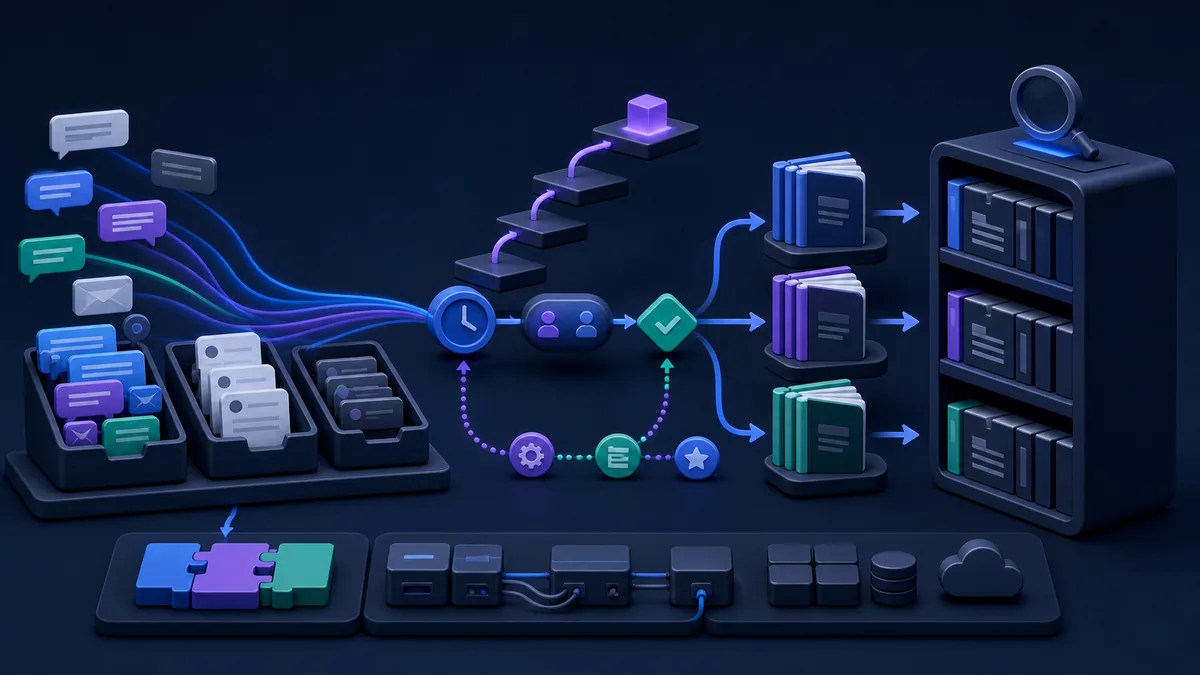
A support knowledge base sits inside a larger operating system: ticket intake, article ownership, search, permissions, AI use, reporting, and escalation. Intercom, Zendesk, and Help Scout package those pieces differently. Compare the workflow and plan you will actually run, then test content migration and agent use with representative data.
TL;DR verdict
Use conditional requirements, not a category rank. Intercom combines helpdesk, integration, knowledge, and AI surfaces. Zendesk connects support plans with Knowledge resources. Help Scout packages Inbox, channels, Docs or knowledge bases, workflows, SLAs, and AI by plan. Shortlist the products whose current source-specific capabilities match the support workflow, then run a representative migration test.
There is no universal winner. The decision turns on channels, article governance, search, AI policy, permissions, integrations, reporting, seat and usage units, and how well imports and exports preserve a real article set.
Key takeaways
- Build a same-day pricing ledger that separates seats, AI, add-ons, channels, and billing cadence.
- Test one vendor-specific integration at the selected plan boundary, including import and export behavior.
- Keep every capability plan-specific. A product page does not prove that a feature is included in the plan under review.
- The reviewed first-party evidence contains no comparable ratings dataset and no employment or staffing outcome dataset.
- The reviewed sources contain no reproducible comparative study of resolution quality, support speed, migration effort, or ownership cost.
At a glance
| Product | Documented shape | Consider it when | Verify in the trial |
|---|---|---|---|
| Intercom | Helpdesk, integrations, knowledge, and AI surfaces | The required conversation, knowledge, and integration workflow matches the selected plan | Article import, permissions, search, AI policy, channels, reporting, API behavior, export, and total units |
| Zendesk | Plan-dependent support with connected Knowledge resources | Support operations already center on Zendesk's ticket and knowledge model | Guide or Knowledge entitlement, roles, article lifecycle, channels, integrations, export, and annual billing scope |
| Help Scout | Inbox, channels, Docs, workflows, SLAs, and AI by plan | A Docs-centered support workflow and Help Scout's inbox model fit the team | Users, inboxes, Docs sites, AI resolutions, workflows, permissions, import, export, and escalation |
Map the support knowledge workflow
Start with a concrete lifecycle:
- A customer searches before opening a ticket.
- An agent finds or links an article during a conversation.
- A content owner updates the answer after a product change.
- Reviewers approve sensitive or regulated content.
- Search and navigation surface the revised article.
- Reporting shows unanswered queries and stale content.
- The team exports content and metadata for backup or migration.
Assign an owner to every step. The product should be evaluated on the exact channel, identity, permission, and article model used by the team, not on a screenshot.
Compare same-day pricing in compatible units
Intercom, Zendesk, and Help Scout publish seat-, plan-, channel-, and AI-usage-dependent pricing. On 2026-08-25, Help Scout listed Standard at $25, Plus at $45, and Pro at $75 per user per month, AI Answers at $0.75 per resolution, and a Free plan limited to five users, one Inbox, and one Docs site. Zendesk advertised Support Team at $19 with annual billing and separate Suite tiers.
These figures are not a complete cost comparison. The ledger must label seat and AI units, billing cadence, agent seats, light users, channels, AI resolutions, knowledge entitlement, environments, add-ons, support, and expected growth. Recheck all three providers on the same day because the plan boundary matters as much as the displayed number.
Test content, search, permissions, and AI together
Build the trial from a small but realistic corpus: public help articles, internal notes, restricted content, images or attachments, redirects, metadata, and a few queries that currently fail. Test article creation, review, publishing, search, agent retrieval, customer navigation, and rollback.
AI features need an explicit policy. Record which content can be used, how answers cite or link articles, what happens on an uncertain query, how feedback is reviewed, and which usage meter applies. A resolution price does not establish answer quality or a staffing outcome.
Verify integrations and migration
Intercom documents its integration catalog. Zendesk documents Knowledge resources. Help Scout documents its knowledge-base and plan surfaces. For the exact shortlist, test CRM or issue-tracker linkage, messaging channels, identity, API access, webhooks, article import, article export, redirects, and attachments.
Record the read and write direction, refresh cadence, error handling, permissions, and plan entitlement. Explicitly test import/export. Migration should preserve titles, slugs, body formatting, assets, categories, authorship, timestamps, redirects, visibility, and a usable export. Leave any unsupported field unresolved instead of assuming portability.
Evidence cards
- Ratings boundary: the reviewed first-party pages do not provide a normalized ratings, reviews, satisfaction, or adoption dataset across all three products.
- Outcome boundary: no employment or staffing outcome dataset supports claims about headcount, compensation, productivity, or annual business return.
- Availability boundary: selected official pages returned 200 on 2026-08-25. That point-in-time result does not prove service uptime, regional coverage, support quality, export success, or plan continuity.
Methodology and limits
We reviewed first-party pricing, product, integration, and knowledge documentation on 2026-08-25. Vendor pages support bounded statements about their own products; they do not establish a normalized category rank.
The review found no controlled comparison of search quality, migration fidelity, agent efficiency, response time, AI answer quality, or cost. A useful proof of concept holds the article corpus, users, roles, channels, queries, integrations, plan, and scoring rubric constant, then retains raw import, search, export, error, and cost results.
FAQ
Which product should an existing support team test first?
Start with the product that matches the team's current ticket, channel, article, and identity model. Run the same corpus and migration checklist against every shortlisted option before deciding.
Can public plan prices be compared directly?
Not without a scenario. Seats, AI units, channels, knowledge features, add-ons, and billing cadence differ. Price the same users, content, support volume, and AI policy on the same day.
How should AI knowledge features be evaluated?
Use representative customer questions, require article traceability, score incorrect and uncertain answers, review privacy and permissions, and retain the usage meter and raw results.
Related guides
- Intercom vs Zendesk vs Help Scout support desk guide
- Modern support desks: Intercom vs Plain vs Pylon
- Notion vs Confluence vs Slab team knowledge bases
Sources
Accessed 2026-08-25:
The SaaS Tool Evaluation Guide (Free PDF)
Feature comparison, pricing breakdown, integration checklist, and migration tips for 50+ SaaS tools across every category. Used by 200+ teams.
Join 200+ SaaS buyers. Unsubscribe in one click.